
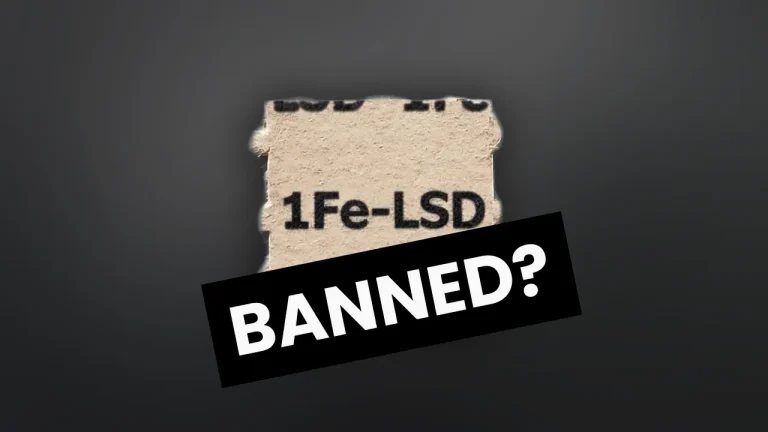
1Fe-LSD Ban: An Overview
- Court ruling in June 2026: The Administrative Court of Cologne ruled that, under the substance group definition in force at the time, 1Fe-LSD was not covered by the NpSG.
- Next important date: On December 1, 2026, the Expert Committee at the BfArM will meet. The agenda includes a draft resolution on amendments to the NpSG and the BtMG.
- Which substances will be affected remains unclear: The published agenda does not name any specific substances or substance groups.
- A committee resolution does not constitute a ban: Further steps would be required afterwards, in particular a regulation, approval by the Bundesrat and publication in the Federal Law Gazette.
- 1BP-LSD and 4-PrO-MET: These substances are also very likely to be in focus.
- No specific ban date yet: As of November 3, 2026, no ban has been adopted.
There have been developments regarding derivatives in Germany. The Expert Committee will meet on December 1, 2026, to discuss amendments and extensions. You can find out here what may become relevant for us this year or at the beginning of next year.
The Current Legal Status: Is 1Fe-LSD Still Legal in Germany?
The legal situation is somewhat more complicated than it may seem at first glance. Although 1Fe-LSD is not explicitly listed in the NpSG, it has already been treated legally as an LSD derivative. What matters is whether the specific chemical structure falls under one of the substance groups described in the law.
This was precisely the issue disputed before the Administrative Court of Cologne in June 2026. In its ruling dated June 29, 2026 (Case No. 1 L 1267/26), the court explicitly stated that 1Fe-LSD was not covered by substance group 5.2 of the annex under the version of the NpSG in force at the time.
In its ruling dated June 29, 2026, the Administrative Court of Cologne explicitly stated, as part of preliminary injunction proceedings, that 1Fe-LSD was not covered by substance group 5.2 of Annex 1 under the version of the NpSG applicable at the time. The court justified this by stating that iron (Fe) is not included in the list of elements specified there.

Why 1Fe-LSD is not yet covered by the NpSG
The NpSG was introduced in 2016 to make it possible to respond to new psychoactive substances without having to explicitly name every new compound in a law. To achieve this, the law defines entire substance groups based on their basic chemical structure and certain permitted modifications.
For LSD derivatives, substance group 5.2 of the annex is particularly relevant. It describes compounds based on the Δ9,10-ergolene core structure and specifies which elements and substituents are permitted at certain positions.
The list is therefore not arbitrarily open-ended. When a new derivative is developed, the decisive factor is whether its structure falls within the existing definition. Even a small chemical modification can therefore make a significant legal difference.
This was already evident with 1S-LSD. With the amendment to the NpSG that came into force on December 2, 2025, silicon was added to the corresponding substance group definition. This brought new variants under the law that had previously not fallen within this definition.
In the case of 1Fe-LSD, the decisive factor is now iron. Since this element was not listed in the definition at the time, the Administrative Court was unable to classify the substance under the relevant substance group.
However, this does not mean that this loophole will remain permanently. The legislator can amend the substance group definition again. This is precisely why the December meeting is so interesting.
Was passiert am 1. Dezember 2026?
On December 1, 2026, the 62nd meeting of the Expert Committee on Narcotic Drugs and New Psychoactive Substances will take place in Bonn.
Under agenda item 6, there is a draft resolution with the following wording:
“Draft resolution on the inclusion of additional substances in Annex III of the BtMG and amendments to Annex 1 of the NpSG”
At first glance, this sounds like a concrete round of bans. However, one crucial detail is missing: the agenda does not name any individual substances or the affected substance groups. The draft resolution itself is also not yet publicly available.
It is therefore not possible to conclude that 1Fe-LSD, 1BP-LSD or 4-PrO-MET are actually on the list. It is equally unclear whether other substance classes will be the main focus of the discussions.
Nevertheless, another difference compared to the previous meeting is worth noting: According to the published report, no comparable resolution items concerning amendments to the substance list were at the centre of the 61st meeting in December 2025. For the December 2026 meeting, however, a draft resolution has been explicitly announced.
This is why one thing is important: Nothing is automatically banned on December 1. The committee evaluates substances and issues recommendations. Only afterwards can the corresponding regulatory process follow.

When does the new New Psychoactive Substances Act come into force?
The next amendment will not simply happen through a vote by the Expert Committee. Several steps separate the expert recommendation from the actual entry into force.
The process for amending the NpSG substance groups generally looks like this:
- Expert Committee: The experts discuss the proposed amendments and adopt a recommendation.
- Drafting of the regulation: Based on this recommendation, the Federal Ministry of Health prepares an amendment regulation. Agreement with the responsible ministries is also required.
- Bundesrat: The regulation requires approval by the Bundesrat.
- Publication: Once the procedure has been completed, the regulation is published in the Federal Law Gazette.
- Entry into force: The date specified in the regulation is decisive. In the case of the most recent amendments, this was only a few days after publication.
This is an important distinction: The committee itself does not impose a ban. It provides the expert basis on which the responsible authorities subsequently proceed.
Amendments to the BtMG follow their own regulatory procedures. Since the agenda for December 1 mentions both an amendment to the NpSG and the inclusion of additional substances in Annex III of the BtMG, the two legislative processes should not be confused.
The NpSG Expert Committee and the 2024/2025 Schedule
Looking back at the past few years helps to better assess the situation. The development of LSD derivatives in Germany has followed a similar pattern several times: a new derivative appears, becomes more widely known on the market and then falls under the NpSG following an amendment to the substance group definition.
With the most recent amendments, things moved particularly quickly once the regulation was finalised.
2024: 1D-LSD
The Fifth Amendment Ordinance to the NpSG was issued on June 21, 2024, and entered into force just six days later, on June 27, 2024. Among other things, this brought additional LSD derivatives under the relevant substance group definition.
In the lead-up, there was considerable speculation about when the amendment would actually take place. As with previous bans, the exact timing was initially difficult to predict. Once the regulation was finally published, however, there was very little time left before it came into force.
2025: 1S-LSD and the expansion to include silicon
A similar pattern emerged at the end of 2025. Following approval by the Bundesrat on November 21, the Sixth Amendment Ordinance was published on December 1. It entered into force just one day later, on December 2, 2025.
The decisive change was the expansion of the relevant substance group definition to include silicon. This also brought the corresponding 1S-LSD variants under the law.
2025 to 2026: A longer lead time for additional groups of substances
Not every amendment proceeds this quickly, however. At the 60th meeting of the Expert Committee on May 13, 2025, more extensive amendments to the NpSG substance groups were recommended. The corresponding amendments did not enter into force until April 12, 2026.
The period between the recommendation and entry into force was therefore almost a year. This shows that the duration of the process depends heavily on how extensive and complex the respective amendment is.
This leads to a mixed assessment for the upcoming meeting: Once a specific regulation has been adopted and published, things can move very quickly. As always, it is not possible to reliably predict how long it will take to reach that point based on previous years.
Ban on LSD derivatives: Which substances are in the crosshairs?
This is currently the biggest source of uncertainty. Although the agenda for December 1 includes a draft resolution to amend Annex 1 of the NpSG, it does not provide a specific list of the substances affected.
Nevertheless, various candidates are already being discussed. The names 1Fe-LSD and 1BP-LSD come up particularly frequently. The reason is that both derivatives have chemical characteristics that are not explicitly covered by the current definition of the ergoline substance group.
In the case of 1Fe-LSD, this is iron. For 1BP-LSD, boron is primarily mentioned as the relevant element. An amendment to the list of permitted elements could therefore affect corresponding compounds.
However, this is not yet confirmation that these exact substances will be discussed in December or subsequently banned. The exact wording of any potential amendment will be decisive. Not every molecule is automatically covered simply because it contains a particular element. The entire chemical structure and the wording of the substance group definition must match.
1BP-LSD and 4PRO-Met in the crosshairs?
4-PrO-MET is also being mentioned in connection with the current discussion. However, it is not an LSD derivative, but rather a substance belonging to the tryptamine group.
The previously mentioned ruling by the Administrative Court of Cologne is also interesting in this context. The court concluded that, under the version of the NpSG in force at the time, 4-PrO-MET was also not covered by the relevant NpSG substance group. The propionyloxy group it contains was not listed among the permitted substituents.
How much longer will 1Fe-LSD remain available?
This is a question that is currently difficult to answer with a specific date. We could see an accelerated procedure or a ban in June/July, as has already happened in previous years. However, one thing is certain: a meeting is approaching at which an amendment to the substance list is explicitly on the agenda.
We can therefore only work with scenarios:
- No relevant amendment: If the substance group is not expanded accordingly, the current NpSG classification will initially remain unchanged. Other legal requirements continue to apply independently of this.
- Recommendation for an expansion: If the committee recommends an amendment, this would be a clear signal. However, it would not yet result in an immediate ban.
- Rapid implementation: If a corresponding regulation is drafted, approved by the Bundesrat and published promptly, an amendment could take effect within a few months – or even within just a few days once the final steps have been completed.
Our assessment: December 1 is the next important point of reference, but not a deadline on which 1Fe-LSD will automatically disappear. Only once the committee’s decision and subsequently the actual regulatory text are available will it be possible to determine whether and from when the derivative will actually be covered.
However, anyone relying on previous developments should also bear in mind that there has been no consistent lead time in recent years. Months may pass between an expert recommendation and an amendment. Once published, however, things can move very quickly.
Successors to 1Fe-LSD following its ban: What comes next?
In the past, it has become clear that new chemical variants have often appeared following changes to the law. 1P-LSD was followed by 1cP, later came 1D-LSD, 1V-LSD, 1S-LSD and finally 1Fe-LSD.
Whether this pattern will continue is, as every year, unclear as long as the final legal text is not available. The broader the substance group definition becomes, the more difficult it will be to find a new variant that is not already covered by the existing provisions.
1BP-LSD is frequently mentioned as a possible alternative in this context. However, it has already been on the market and visible for some time. It is therefore quite clear that if LSD derivatives are reassessed, 1BP-LSD will also be affected.
The chemical starting point is different for tryptamines such as 4-PrO-MET. However, this does not mean that these substances will permanently offer a legal alternative. Other substance groups can also become the subject of an amendment at any time.
Safe handling and storage prior to the change in the law
Stockpiling is frequently discussed in connection with possible bans. Two things should be clearly distinguished here: the legal situation and the safe handling of existing research chemicals.
We explicitly do not recommend purchasing larger quantities in advance based on a suspected change in legislation. As long as neither the exact content of a possible regulation nor its entry into force has been established, such a decision would be speculative. Other regulations may also apply independently of the NpSG.
Anyone who already possesses a research chemical should generally store it in its original packaging, clearly labelled and securely sealed. It should be kept out of reach of children and pets and should not be stored together with food or drinks.
It is also important to reassess the legal situation following an actual change in legislation. If a substance becomes covered by the NpSG, its acquisition and possession may be prohibited. Trading, manufacturing and placing it on the market are also subject to the respective criminal provisions. You should therefore not assume that existing stocks are automatically exempt from an amendment.
Research chemicals are also not intended for human consumption. A label stating Research Chemical is not an indication of tested safety or official approval.
Conclusion: December will be decisive
According to the Administrative Court of Cologne’s ruling in June 2026, 1Fe-LSD is not covered by the version of the relevant NpSG substance group definition that was in force at the time. A further amendment to the substance group definition would be required for a corresponding ban.
This very possibility makes the Expert Committee meeting on December 1, 2026, so relevant. The agenda includes a draft resolution to amend the NpSG, but does not name any specific substances. Whether 1Fe-LSD, 1BP-LSD or other derivatives will actually be affected therefore remains unclear for now.
The experience from 2024 and 2025 shows that only a few days may pass between a completed regulation and its entry into force. However, the longer lead time for the amendments from 2025 to 2026 also shows that the entire process cannot be reliably predicted.
We will keep you updated on further developments. As soon as specific recommendations, a draft regulation or a Bundesrat resolution become available, the situation can be assessed much more accurately. Until then, the key is not to confuse rumours with an adopted ban and to keep an eye on the actual legal text.
Sources and further information
Verwaltungsgericht Köln – Beschluss vom 29.06.2026, Az. 1 L 1267/26
Bundesgesundheitsministerium – Sachverständigenausschuss nach BtMG und NpSG
Bundesgesundheitsministerium – Chronik der NpSG-Änderungsverordnungen
Bericht zur Tagesordnung der 62. Sitzung am 1. Dezember 2026
Note: This article is intended for general informational purposes and does not constitute legal advice. The applicable laws, regulations and court decisions in force at the relevant time are authoritative.


